


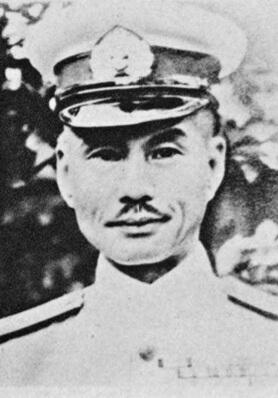
Japanese Rear Admiral Sanji Iwabuchi carried a heavy burden. In November 1942, the USS Washington's guns had sent his battleship Kirishima to the bottom of the ocean off Guadalcanal. He survived. In Japanese military culture, that survival brought immense disgrace.
Two years later, commanding naval forces in Manila, Iwabuchi saw his chance at redemption. General Tomoyuki Yamashita ordered him to abandon the Philippine capital. Iwabuchi refused, choosing to sacrifice himself and the lives of his men so he could regain a sense of honor. His decision to fight to the death would transform Manila into the most savage urban battlefield of the Pacific War and kill more than 100,000 Filipino civilians in just a month of combat.
"In a way we were all massacred," survivor Servillano Aquino later testified. "Only, some of us were fortunate to have lived through it."
The Race for Manila
On January 9, 1945, Lt. Gen. Walter Krueger's Sixth Army stormed ashore at Lingayen Gulf. General Douglas MacArthur had waited nearly three years for this moment. He had fled the Philippines in March 1942, famously vowing to return.
MacArthur wanted Manila, the Pearl of the Orient, immediately. Maj. Gen. Oscar Griswold, commanding the XIV Corps, was ordered to take the city.
Maj. Gen. Verne Mudge of the 1st Cavalry Division was given the orders, "Go to Manila! Go around the Nips, bounce off the Nips, but go to Manila. Free the internees at Santo Tomas."
Mudge assembled 800 troopers into a "Flying Column." They tore south across Luzon at breakneck speed, sometimes hitting 50 miles per hour. Oscar Nipps, an 18-year-old cavalryman, remembered the urgency.
"We were 88 miles from Manila when MacArthur sent the trucks to get us," he recalled. "We made 88 miles in 66 hours, driving through a combat zone."
From the south, Maj. Gen. Joseph Swing's 11th Airborne Division landed at Nasugbu on January 31. On February 3, his 511th Parachute Infantry Regiment jumped onto Tagaytay Ridge in the division's first combat jump of the war. The paratroopers pushed north toward Manila's outskirts, where Japanese defenses were waiting.
Maj. Gen. Robert Beightler's 37th Infantry Division advanced from the north. The Ohio National Guard outfit was known as the “Buckeye Division” and had already earned its reputation in brutal jungle fighting on Bougainville.
What awaited in Manila would eclipse everything they had seen before.

The Filipinos Who Made Victory Possible
Filipino guerrillas proved essential to the battle. Captain Manuel Colayco, a newspaperman turned intelligence officer who had survived the Bataan Death March, guided the Flying Column through the outskirts of Manila. He led them around mined roads and ambush points the Japanese had prepared.
Josefina Guerrero was a 27-year-old woman suffering from Hansen's disease. Her illness made Japanese soldiers recoil in fear. "I'm a leper," she would cry if a sentry approached her. No one wanted to search her. She became the perfect resistance member.
In late January 1945, Guerrero received her most dangerous mission. "You had better go to confession and make a good act of contrition," her commander told her, “For you will not be coming back." Her job was to carry a map of minefields guarding Manila to American headquarters 35 miles north.
Despite paralyzing fatigue and headaches, she taped the map to her back and set off on foot. She walked 25 miles to Hagonoy, took a boat around an active combat zone while outrunning river pirates, then walked another eight miles to Calumpit. When she arrived, the Americans had already moved to Malolos. So she turned around and kept walking.
She delivered the map to Captain Blair of the 37th Infantry Division. Her intelligence allowed American troops to navigate the minefields safely. Guerrero then advanced with them into the city, tending to wounded soldiers and civilians and carrying children to safety through enemy bullets.
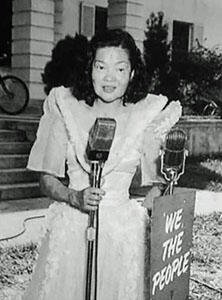
Maj. Gen. George F. Moore, the former commander of harbor defenses at Corregidor who had spent three years as a Japanese POW, later said Guerrero had, "more courage than that of a soldier on the field of battle." She received the Medal of Freedom with Silver Palm in 1948.
The Hunters ROTC guerrillas, composed largely of young military academy cadets, fought alongside American forces from Nasugbu all the way to the Manila General Post Office. Under Lt. Col. Emmanuel V. de Ocampo, they provided what intelligence officers called "the best intelligence data on Luzon."
Filipino soldiers and resistance fighters would play a vital role in assisting the U.S. Army in liberating Manila.
Liberating the Prisoners
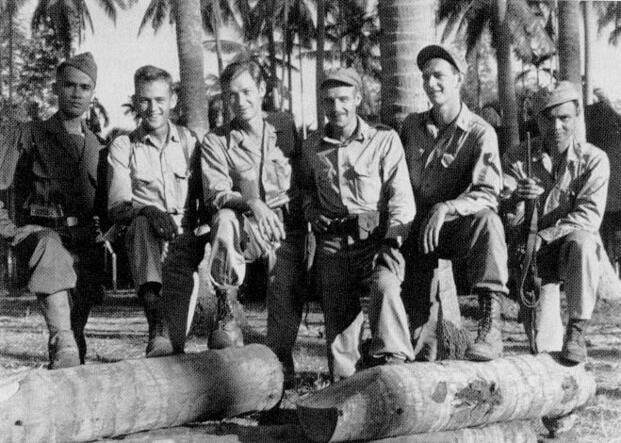
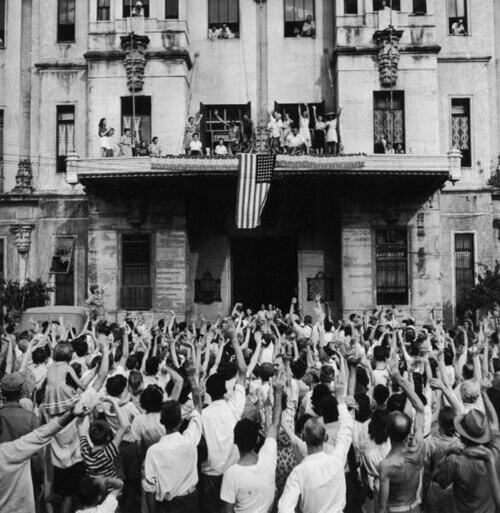
Shortly before 9 p.m. on February 3, the Flying Column's Sherman tanks crashed through the gates of Santo Tomas University. The Japanese had held civilian internees there for nearly three years. Many prisoners were near starvation. Some had lost a third of their body weight.
As the column approached the gate, Japanese soldiers opened fire, striking Colayco in the midsection. He died seven days later in a field hospital. The university later erected a plaque in his honor at the spot where he was mortally wounded.
Nine-year-old Angus Lorenzen was among the 3,700 internees. After American soldiers dug a foxhole near his family's shanty, he peppered them with questions about their weapons.
"One of them handed me a candy bar," Lorenzen recalled decades later. "And, oh boy, you know, I hadn't had a candy bar in three years."
The Japanese garrison commander had prepared a horrendous contingency to prevent the liberation. Drums of gasoline sat around the compound with detonators in place. He planned to burn the internees alive. The speed of the tank assault prevented the Japanese from carrying out the plan.
The next day, the 37th Infantry Division freed more than 1,000 POWs at Bilibid Prison. Men who had survived the surrender and Bataan Death March three years earlier were finally free.
As the division began pushing into the city on February 5, the Japanese set Chinatown ablaze. Flames trapped 2nd Lt. Robert Viale's platoon from Company K, 148th Infantry while a machine gun blocked their only escape. Several civilians were with them. Viale led an assault on the position.
As he climbed a ladder and prepared to toss a grenade, it slipped from his hand, falling between his men and the civilians. He dropped from the ladder and quickly smothered it with his body. Though he was killed, his sacrifice allowed everyone to escape. Viale received the Medal of Honor posthumously.
MacArthur declared Manila was liberated a day later on February 6. In reality, the battle had just begun.
The 11th Airborne Attacks Iwabuchi's Fortress
While MacArthur announced victory prematurely, Iwabuchi's Manila Naval Defense Force was still holding most of the city. He commanded roughly 17,000 sailors and soldiers. Many were naval personnel who knew nothing about infantry tactics. They were still expected to die like any other Japanese defender.
The Japanese had transformed Manila into a killing ground. More than 350 antiaircraft and dual-purpose guns guarded the city. Some came from wrecked warships in the harbor. Pillboxes overlooked most intersections. Mines and improvised explosives lined the streets. Buildings became bunkers.
Approaching the city from the south, the 11th Airborne slammed into the Genko Line. This defensive belt stretched across Manila's southern edge with minefields, pillboxes, and naval guns creating interlocking fields of fire. The Japanese Naval Air Service had positioned antiaircraft weapons at Nichols Field to shoot American planes overhead or aim directly at the advancing paratroopers.
The battle for Nichols Field was one of the bloodiest of the entire Luzon campaign. Fortified pillboxes guarded the installation, protecting all roads leading to the airstrip, supported by dual-purpose guns. From the outer rim, the Japanese poured in fire from five-inch naval guns.
One airborne officer took the oppurtunity to send a message up the chain of command.
Tell Admiral Halsey to stop looking for the Jap Fleet. It's dug in here on Nichols Field.
Lt. Andrew Carrico of the 11th Airborne later recalled the fight.
"Day by day we advanced as best we could," he said. "Some days we did not get very far, sometimes yards. Most of the period between February 4-22 was pretty heavy fighting all the time."
The paratroopers finally took Nichols Field on February 12 after a week of brutal combat. They then began a flanking movement around Fort McKinley later that day.
On February 13, the advance stalled at a final pillbox blocking the approach. PFC Manuel Pérez Jr., lead scout for Company A of the 511th, flanked the position alone. He killed 18 Japanese troops with grenades, rifle fire and even his bare hands when an enemy soldier knocked his weapon away.
After Pérez’s heroic charge, the paratroopers of the 11th Airborne were able to knock out the remaining defenses and resume their advance.
As their positions were slowly being overrun, the Japanese detonated a mass of buried naval depth charges, causing the 11th Airborne to suffer heavy casualties. Ignoring the losses, the paratroopers assaulted the fort anyway. The 511th led the break-in, and by February 18 the area fort was cleared, finally breaking open the Japanese defensive line.
The fighting for Fort McKinley cost the 11th Airborne one of its finest officers. Colonel Orin D. "Hard Rock" Haugen, commander of the 511th Parachute Infantry Regiment, was injured by shrapnel and died on February 22.
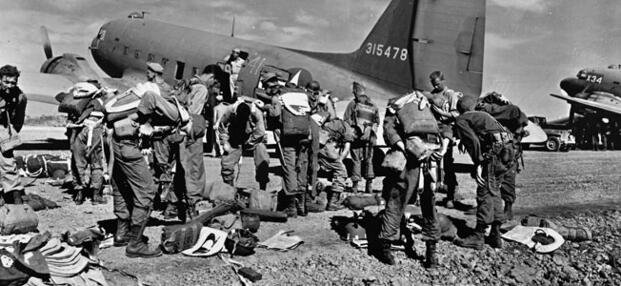
On February 23, the paratroopers and the Hunters ROTC conducted a raid on Los Banos internment camp, liberating more than 2,000 American and European civilians 40 miles behind enemy lines.
By this point, half of the 511th PIR had been killed or wounded. Their rapid amphibious assault, followed by their first combat parachute jump of the war, managed to cut Japanese forces in Manila off from supply, reinforcements and escape.
Pérez was killed in action by an enemy sniper a month later. He received the Medal of Honor posthumously for his actions.
The 37th Infantry Division Crosses the Pasig
As the paratroopers began their assault on Japanese defenses in the south, the Buckeye Division continued moving into the northern portions of the city. On February 7, General Beightler ordered the 148th Infantry Regiment to cross the Pasig River and clear the Paco and Pandacan districts.
At 3:15 p.m., infantrymen boarded assault boats at Malacanan Palace and began paddling across. The first wave encountered no resistance, landing at the Malacanan Gardens. But the Japanese 1st Naval Battalion counterattacked quickly, pinning down the Americans. Japanese rocket artillery began shrieking overhead. Though inaccurate, the nerve-wracking weapons impeded the American assault.
The bitterest fighting occurred on Provisor Island, a small industrial center containing the city's steam-driven power plant. A Japanese battalion held off Beightler's infantrymen for days. On February 9, the 37th Infantry Division lost 19 dead and 216 wounded in a single day. It was more than the division had suffered in the entire Luzon campaign to that point.
The 129th Infantry Regiment lost dozens of men killed and wounded securing the objective. However, the division had finally broken into the southern portions of the city.
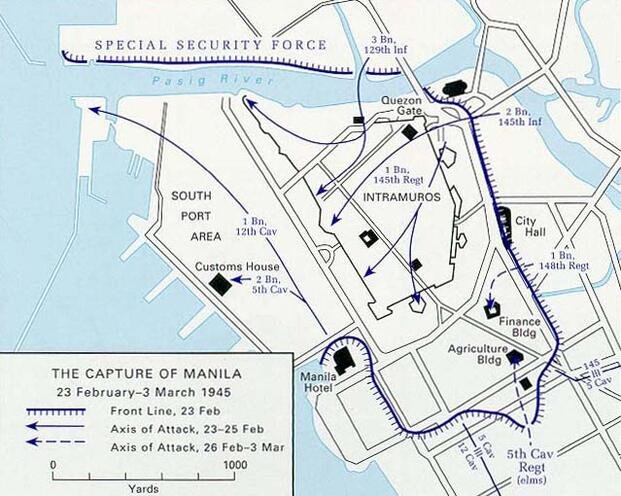
The Battle of Manila
MacArthur had forbidden air strikes and restricted artillery to protect civilians. That order was ignored as the reality of Japanese resistance became apparent. By February 9, American shelling had set entire districts ablaze.
General Beightler later said, "If the city were to be secured without the destruction of the 37th and the 1st Cavalry Division, no further effort could be made to save buildings. Everything holding up progress would be pounded."
Troops from the 1st Cavalry began pouring in from the south and east, facing fierce resistance from Japanese defenders. Across the city, the 37th Infantry had to move methodically against prepared Japanese defenses. Enemy snipers, anti-tank guns and machine guns waited around every corner.
On February 9, Private Cleto Rodriguez of Company B, 148th Infantry Regiment, showed how individual soldiers could break the Japanese defenses. His platoon was pinned down 100 yards from the heavily defended Paco Railroad Station. Three companies of Japanese marines were fortifying the building.
Rodriguez, a 21-year-old automatic rifleman from San Antonio, left the platoon on his own initiative. Accompanied by Private John N. Reese Jr., he advanced to a house 60 yards from the station. For an hour, under constant enemy observation, the two men fired at targets of opportunity, killing more than 35 Japanese soldiers.
They pushed closer. When Japanese replacements tried to reach the pillboxes, Rodriguez and Reese opened fire, killing more than 40 and stopping all subsequent attempts. At 20 yards from the station, Rodriguez threw five grenades through a doorway, killing seven more enemies, destroying a 20mm gun and wrecking a heavy machine gun.
Running low on ammunition, the two men fought their way back to American lines. Reese was killed covering Rodriguez's withdrawal. In two and a half hours, the pair had killed more than 82 Japanese soldiers, completely disorganized the enemy defense and paved the way for the subsequent capture of the railroad station.
Rodriguez became the first Mexican American to receive the Medal of Honor in the Pacific Theater. Reese received the award posthumously.
That same day at the Manila Gas Works, Pvt. Joseph Cicchetti of Company A spent four hours under fire, assembling litter teams and rescuing 14 wounded men. A shell fragment killed him while carrying another soldier to safety. He earned the Medal of Honor posthumously for his actions.
The 37th Division's official history captured the scope of the horror in a single sentence. "For those who missed Normandy or Cassino, Manila would do."
Beightler later addressed Ohio legislators about what his men endured.
"Day and night, week after week, fighting, dying, snatching a wink of sleep in a rubble heap with bullets splattering the walls around, dashing into almost certain death with never a semblance of faltering," he said. "Such was the life of the doughboy fighting in Manila."
The Japanese Atrocities
As their perimeter shrank, Japanese troops turned their attention on Filipino civilians. War crimes investigators later described the massacres as "an orgy of mass murder." The killing was systematic.
Japanese orders captured after the battle stated, "When Filipinos are to be killed, they must be gathered into one place and disposed of." Arson became the preferred method to spare ammunition, herding groups of civilians into buildings before setting them ablaze.
Lt. John Hanley and his platoon from the 37th Infantry surveyed the Dy Pac Lumberyard in northern Manila. Among the weeds, they found bodies in flower-print dresses, nightgowns and infant sleep suits. Japanese soldiers had beheaded the men and bayoneted women and children, including babies.
At De La Salle College a few days later, Japanese marines bayoneted 41 people in the chapel. The victims included 16 religious brothers as well as women and children as young as two years old. A survivor recalled that after the massacre, Japanese soldiers returned "to laugh at the dying."
The Bay View Hotel became what survivors called a "rape center." For more than a week, Japanese troops assaulted hundreds of women. Esther Garcia Moras later testified. "I was raped between 12 and 15 times during that night. I cannot remember exactly how many times. I was so tired and horror stricken that it became a living nightmare."
At Fort Santiago, the Japanese herded the civilians into dungeons. Dr. Antonio Gisbert survived to tell of it. "I am one of those few survivors, not more than 50 in all out of more than 3,000 men herded into Fort Santiago and, two days later, massacred."
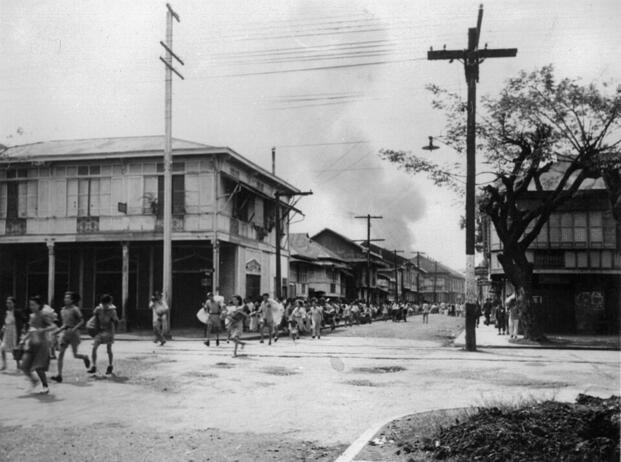
Storming the Walled City
By late February, Iwabuchi's remaining forces had retreated into Intramuros. The ancient Spanish-era fortress had walls 22 feet high. An estimated 2,000 Japanese defenders occupied the 160-acre citadel. They held thousands of Filipino civilians as human shields.
Nine battalions of American artillery pounded Intramuros from February 17 to 23, firing 185 tons of ammunition.
Army historian Robert R. Smith wrote that XIV Corps and the 37th Division "planned a massive artillery preparation" including "direct, point-blank fire from ranges as short as 250 yards."
Beightler surveyed the aftermath.
We made a churned-up pile of dust and scrap out of the imposing, classic government buildings.
Infantry from the 37th Division stormed the breaches on February 23. The 148th Infantry attacked through the holes made in the walls between the Quezon and Parian Gates. The 129th Infantry crossed the Pasig River and attacked near the Government Mint.
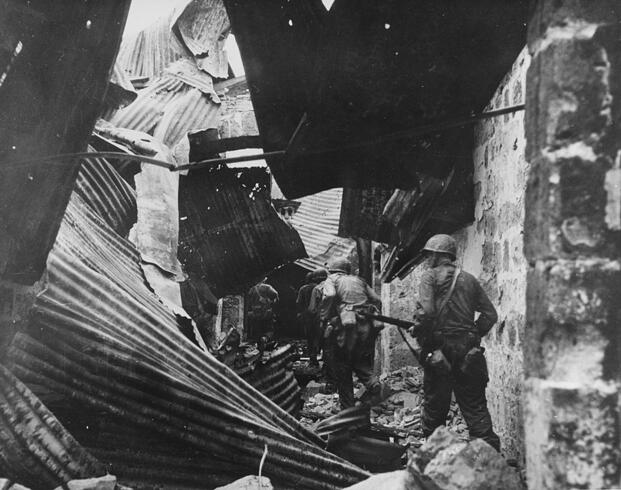
They fought through the ruins room by room. The Japanese released about 3,000 Filipino hostages during the fighting but only after murdering most of the men in the group.
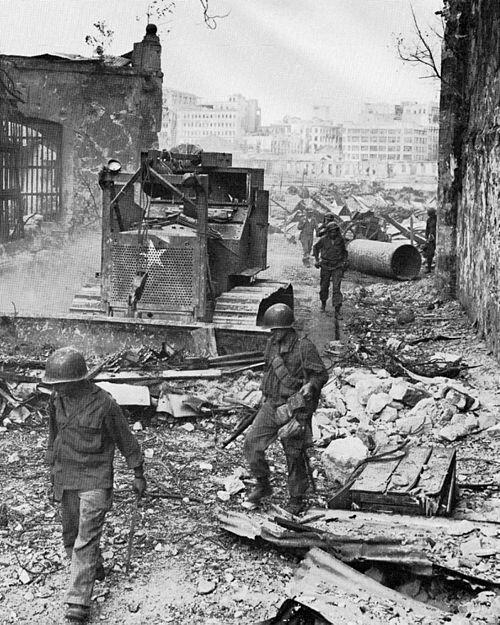
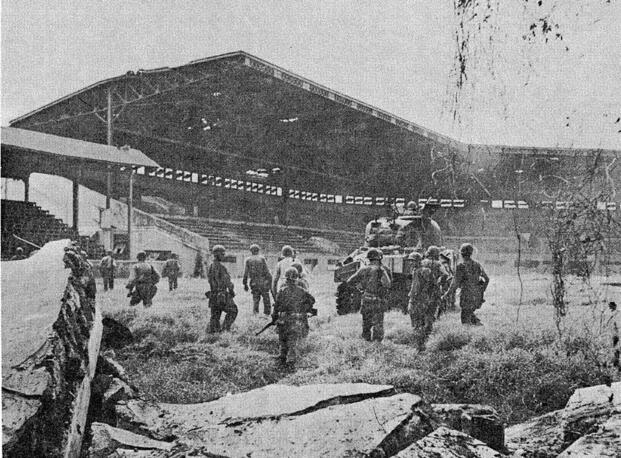
The 1st Cavalry Division, fighting south through the port district, reached Manila Bay on February 12. Over the following days they seized Fort San Antonio Abad and Rizal Stadium. As the 37th assaulted Intramuros on February 23, the 1st Cavalry pushed toward the Customs Building.
As they approached the building, Japanese fire cut down a troop commander in the open.
PFC William Grabiarz sprinted from cover to drag him to safety and took a bullet in the shoulder. When he couldn't move the officer, he used his own body as a shield. Grabiarz died under enemy fire, though the officer survived. He earned the Medal of Honor for his sacrifice.
The fighting for the surrounded government buildings dragged on for days. The Legislature Building finally fell on February 27 after artillery reduced the north and south wings to rubble, leaving only the central portion standing. Infantry of the 148th Regiment then fought hand to hand through the wreckage. The Finance Building, the last Japanese strongpoint, fell on March 3.
At the end of February, Iwabuchi gathered his remaining staff in the Agriculture Building. He bid them farewell and committed suicide. His body was never found. He received a posthumous promotion to vice admiral.
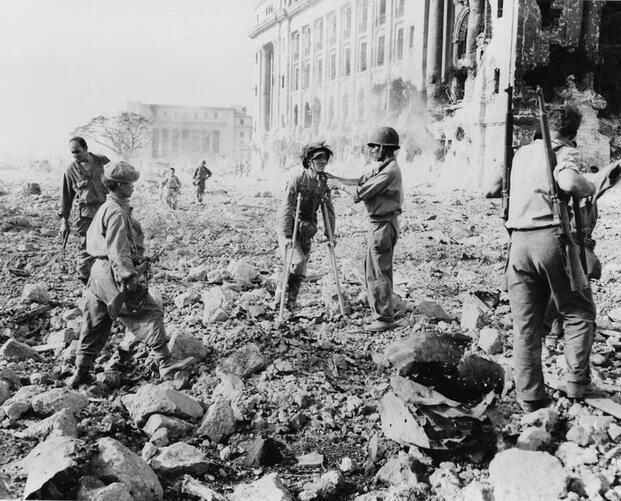
A City of Ashes
When the fighting ended, Manila lay in ruins comparable only to Warsaw and Stalingrad. More than 600 city blocks had been flattened. Seventy percent of utilities, 72 percent of factories and 100 percent of the business district were destroyed.
American forces suffered 1,010 killed and 5,565 wounded. Filipino military and resistance losses are unknown. Over 16,000 Japanese soldiers were killed in the city. But the civilian toll dwarfed all military losses. At least 100,000 Filipino civilians died. Some estimates reach 240,000.
American artillery may have caused 40 percent of civilian deaths after restrictions were lifted on February 9. The rest fell to Japanese bayonets, arson and gunfire.
A report from the 112th Medical Battalion, part of the 37th Infantry Division, described Manila south of the Pasig River as "a fantasia of death and destruction."
"One hundred Filipinos died for every one U.S. soldier," noted historian James M. Scott. "It literally was a battle borne on the backs of the men, women, and children of Manila."
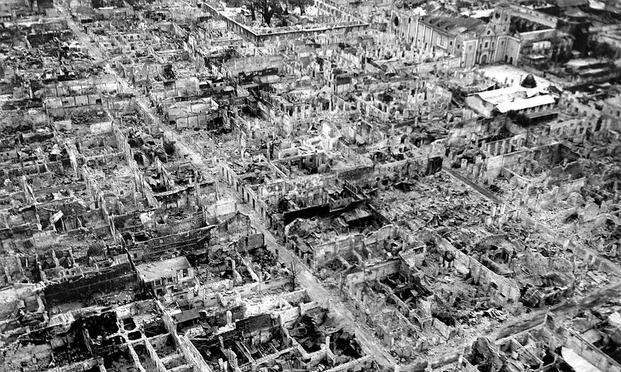
The Reckoning
MacArthur ordered immediate documentation of Japanese crimes. Investigators fanned through the ruins, interviewing survivors in hospital beds and photographing massacre sites. Their work produced thousands of pages of sworn testimony.
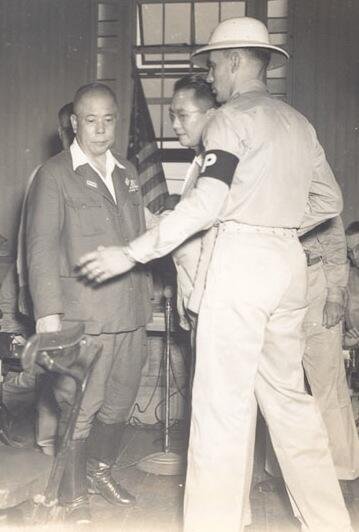
General Yamashita stood trial for the atrocities in October 1945. He had ordered Iwabuchi to evacuate Manila, though that order was ignored as Iwabuchi's troops committed most massacres. While those men had not been under Yamashita's direct command, the blame fell squarely on his shoulders as the overall commander.
The military tribunal found Yamashita guilty. He was hanged on February 23, 1946. The verdict established command responsibility as a principle of international law.
1st Cavalry veteran Robert R. Harrison returned to the Philippines decades later for reunions with Santo Tomas survivors. He never forgot what he witnessed.
"I don't think it's possible to fully recover from the effects of so much death and destruction and the dehumanizing impact of prolonged warfare," Harrison said. "I don't want this to be self-serving. I'm not making myself into a hero. I'm just one of a group of people."
Today, the Memorare-Manila 1945 Monument stands in Intramuros. A bronze sculpture depicts a grieving mother cradling a dead child. The inscription honors the 100,000 civilians who perished, "Let this monument be the gravestone for each and every one."
Manila survivor Isabel Caro-Wilson, interviewed years later, offered a response that many of her countrymen share.
"I can't be angry all my life," she said. "Have I forgiven? Of course, I have. But I haven't forgotten."
The Battle of Manila was the bloodiest urban battle American troops fought in the Pacific War. Of the 22 Medals of Honor awarded to troops during the Luzon Campaign, six were given to troops of the 11th Airborne, 1st Cavalry and 37th Infantry Divisions fighting in and around Manila. When civilian deaths are included, Manila ranks as one of the deadliest battles in all of World War II.


")





