


Families of two West Virginia veterans received a little bit of closure when it was announced this week that their remains have been identified after several decades.
Sgt. William L. Harper, a Korean War soldier from White Sulphur Springs, and Pvt. Ira Warren from Seth, a World War II veteran, were both identified last year thanks to the Defense POW/MIA Accounting Agency (DPAA). Harper was accounted for on Aug. 7 while Warren was accounted for on June 11.
DPAA held off on informing the public until the soldiers’ families could be fully briefed on the findings.
Identified Decades Later
Warren, 26, served in the Philippines with the Headquarters Company, 194th Tank Battalion, according to the DPAA.
In December 1941, the Japanese military invaded the islands, kicking off an intense period of fighting through April 9, 1942, when Allied troops on the Bataan peninsula were forced to surrender. Almost a month later, on May 6, Corregidor Island also fell to Japanese forces.

Following the surrender, Warren reluctantly joined thousands of captured members of both the U.S. and Filipino armies on the Bataan Death March—a grueling 65-mile trek to the Cabanatuan POW camp. Many died along the way, subjected to abuse and malnutrition.
Based off POW and historical records, Warren’s date of death was listed as July 19, 1942. According to the DPAA, the Cabanatuan camp claimed the lives of more than 2,500 POWs. They were buried at the camp’s cemetery.
After the war, Warren’s remains—along with 39 other soldiers—were recovered from Common Grave 312. Out of those 40, 28 bodies were unidentified, buried as “Unknowns” at the Manila American Cemetery and Memorial (MACM).
In January 2018, the “Unknowns” from Common Grave 312 were removed from the cemetery in Manila by the DPAA’s Cabanatuan Project for DNA testing. It took more than seven years, but in 2025, using modern DNA techniques, Warren’s remains were properly identified.
More than eight decades have passed since Warren’s death. But later this spring, the Army private will finally be laid to rest at a cemetery in Bloomingrose, West Virginia. The DPAA said that while Warren was marked as unidentified, the American Battle Monuments “took meticulous care” of his grave for 70 years.
MIA Soldier Coming Home
Harper, 21, served in the Korean War with D Battery, 82nd Antiaircraft Artillery Automatic Weapons Battalion, 2nd Infantry Division. On Feb. 13, 1951, he was reported missing in action (MIA) following the Battle of Hoengsong in South Korea.
Harper, based on DPAA accounts, was taken prisoner by enemy forces and sent to Prisoner of War Camp 1 in Changsong, North Korea. He died there as a POW in August 1951.
In 1954, during Operation Glory, North Korea agreed to unilaterally hand over remains of American soldiers to the U.S. Remains were recovered from POW camps, isolated graves and United Nations cemeteries. Harper’s remains, however, were declared non-identifiable and the veteran could not be recovered at the time.
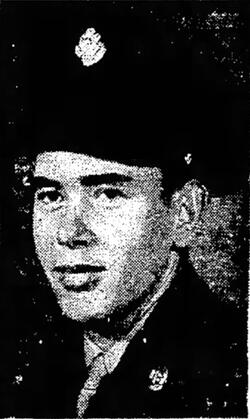
Harper’s unidentified remains were sent to Honolulu, Hawaii, and buried at the National Memorial Cemetery of the Pacific, more commonly known as the Punchbowl.
In July 2018, the DPAA embarked on a mission to disinter 652 unidentified Korean War soldiers from the Punchbowl to try to identify them using DNA science.
In February 2020, DPAA scientists began analyzing the remains of a Korean War soldier, and after more than five years, those remains were identified as Harper’s.
The DPAA said Harper is expected to be buried in White Sulphur Springs later this year. For decades, his name had been listed among many others from the Korean War on the Punchbowl’s Courts of the Missing.
Now that his remains have been found, his name will not be removed though a rosette will be placed next to it, signifying Harper has been identified.

")





