


When Air Force Lt. Col. Robert Stirm was released from a prisoner of war camp in Vietnam in 1973, surviving 1,966 days in captivity, his thoughts were consumed with finally reuniting with his family.
That joyous moment at Travis Air Force Base in California was captured by Associated Press photographer Sal Veder, who earned a Pulitzer Prize for the iconic image, a moment of pure happiness that was shared throughout newspapers across the country and became a historic depiction of life, service and sacrifice during a long and unrelenting war.
Stirm died on Veterans Day at an assisted living home in Fairfield, California. He was 92.
In the photo, Stirm is running towards his family, four children and a wife, ready to embrace them after years of imprisonment kept them apart for so long. His eldest daughter, Lorrie, 15, is seen with arms outstretched and an expression of pure euphoria on her face, ready to hug her dad.
Appropriately, the photo is called “Burst of Joy.”

Photo Conjures Emotions
Stirm’s daughter, now 68 and known as Lorrie Stirm Kitching, has a copy of the photo displayed in her home in Mountain View, California.
“It’s right in my front foyer,” Kitching told the AP.
More than 50 years later, the iconic photo still stirs emotions for Kitching.
“Just the feelings of that and the intensity of the feeling will never leave me,” Kitching said. “It is so deep in my heart, and the joy and the relief that we had our dad back again. It was just truly a very moving reunion for our family, and that feeling has never left me. It’s the same feeling every time I see that picture.
Kitching said the image reminds her every day how grateful she was to have Dad come home alive when so many POWs did not.
“That was really a gift,” Kitching said.
Shot Down Over Vietnam
By the time Stirm was serving a tour in Vietnam, he had been in the Air Force for almost 15 years and was a highly successful pilot. He was based out of Takhli Royal Thai Air Force Base with the 333rd Tactical Fighter Squadron.
On Oct. 27, 1967, however, Stirm’s F-105 Thunderbird was attacked during a bombing mission in North Vietnam. He tried parachuting to safety but was shot three times. Barely after hitting the ground, Stirm was taken prisoner.
The Air Force pilot was moved to five separate POW installations throughout his five years and four months in captivity. He spent time in the brutal “Hanoi Hilton,” a prison that became infamous for its tales of torture and starvation. “Hanoi Hilton” imprisoned many U.S. pilots, including the late Sen. John McCain, whose Navy bomber was also shot down in 1967.
Stirm and McCain met in captivity, their cells separated by a wall during solitary confinement. They created a tapping code to communicate with each other.
“John McCain tapped in this joke. First time Dad laughed in jail,” Kitching said. “I just wish I knew what that joke was. I’m sure it was something very ribald.”
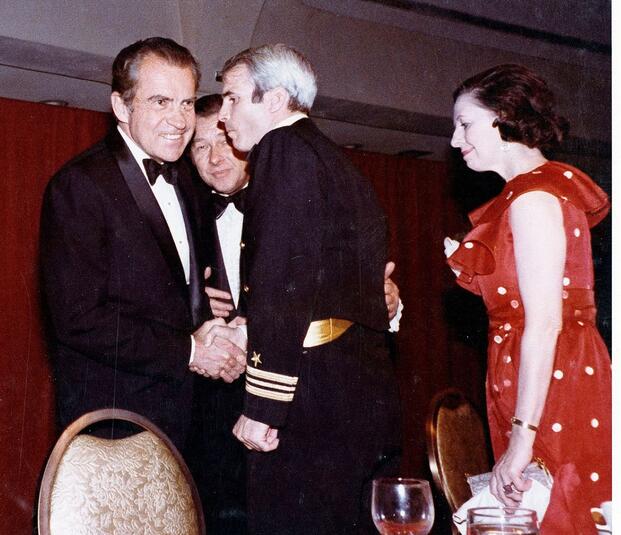
Image Depicts Joy and Heartbreak
While the moment represented joy and relief for his daughter, it was bittersweet for Stirm.
He was 39 when the photo was taken, and while he kept several copies of the image, he didn’t hang it up in his home. When he was released from the POW camp, a military chaplain walked up to him and handed him a letter – a “Dear John” note from his wife, Loretta.
“I have changed drastically — forced into a situation where I finally had to grow up,” read a portion of the letter. “Bob, I feel sure that in your heart you know we can’t make it together — and it doesn’t make sense to be unhappy when you can do something about it. Life is too short.”
Stirm told the AP in an interview 20 years after the photo was taken that it became “kind of unwelcome.”
“The photo brought a lot of notoriety and publicity to me and, unfortunately, the legal situation that I was going to be faced with,” Stirm said.
Stirm and his wife divorced about a year following the photo’s publication, and they both moved on and married other people shortly after. As their children married, they would come together for weddings and family activities. Loretta Adams died in 2010 at age 74 after a bout with cancer.
“It hurt really deeply,” Kitching told the AP. “She told him she wanted to make the marriage work. But she was being up front and honest. So, every story has two sides, and I know very well just how difficult it is to understand the two sides.”
In 1977, Stirm retired from the Air Force after a 25-year career. He spent time working at Ferry Steel Products, a company founded by his grandfather in San Francisco, and served as a corporate pilot.

")





